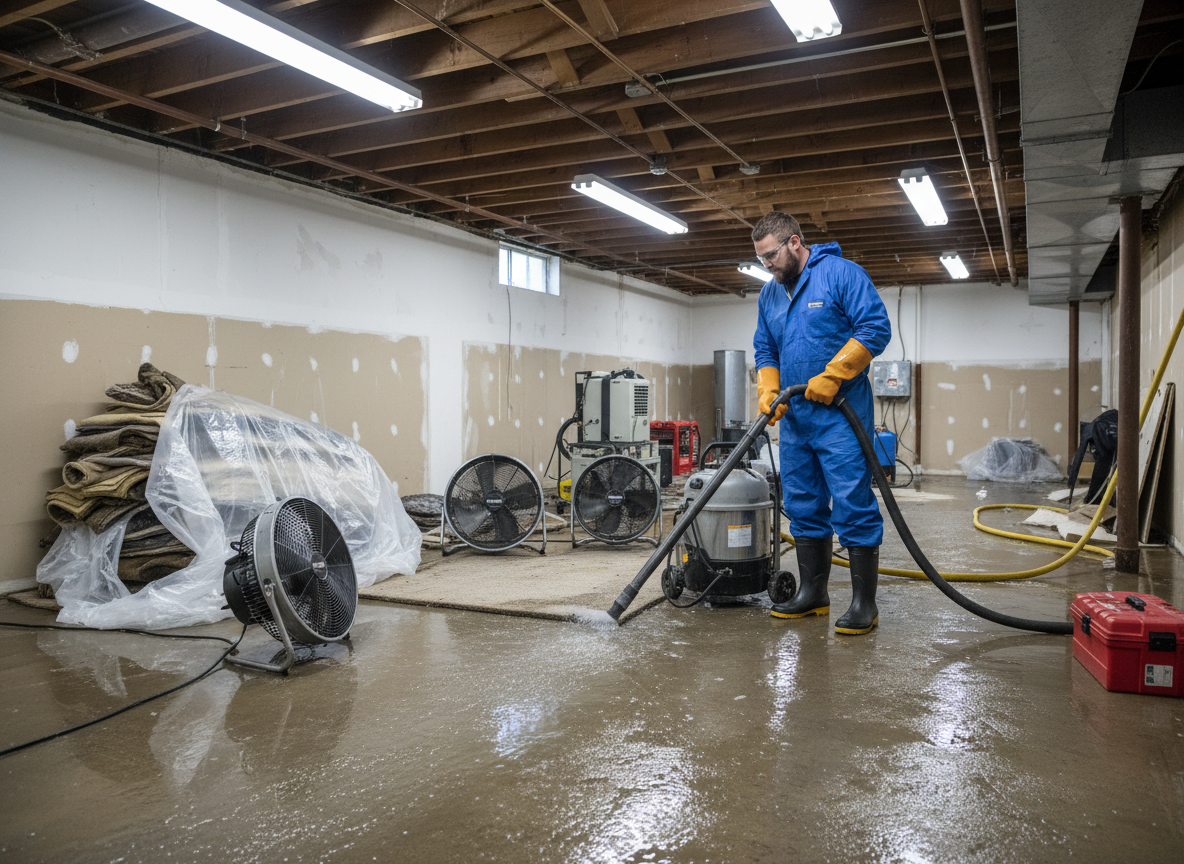
Downey's post-war housing stock along Lakewood Boulevard and near the Rio Hondo Golf Club often features original galvanized supply lines and slab-on-grade construction. When a supply line fails under the slab, water travels laterally under the concrete and into adjacent rooms, saturating drywall from the bottom up. Infrared moisture mapping is required to locate the full extent before demolition begins, because visual inspection alone misses pockets trapped behind cabinets or under vinyl flooring common in these homes.
Los Angeles County's Mediterranean pattern of hot, dry summers followed by sudden winter downpours creates a second risk: roof and window leaks around older aluminum frames. Water enters at the stucco transition and migrates downward, feeding mold on the paper face of drywall within 48 hours. Emergency crews must remove baseboards and drill weep holes at the bottom plate to allow airflow; otherwise residual moisture reappears weeks later as musty odors in closets.
Properties near Rancho Los Amigos and Columbia Memorial Space Center sit on flatter terrain with heavier clay soils that slow drainage. After a main-line backup or appliance failure, standing water can remain against foundations for days. Technicians use air movers and dehumidifiers sized for the square footage while monitoring relative humidity hourly to prevent secondary damage to hardwood floors found in many mid-century Downey residences.
Work in Bell Gardens and Paramount cross-city lines requires coordination with local permitting when structural members are exposed. Crews document every cut and photograph hidden conditions so homeowners have records for insurance adjusters who frequently question the scope on slab leaks.
Technician insight
In Downey the thing that catches most people out with Emergency Water Cleanup is the way water travels under those 1950s slab foundations near the Downey Civic Theater. Homeowners see a wet carpet in the living room and think the problem is small, but the clay soil and flat lots let water spread twenty feet under the concrete before it shows up in the next room.
Slab Leak Near Rancho Los Amigos
A homeowner in a 1958 ranch near Rancho Los Amigos noticed damp carpet after a hot day. Extraction revealed water had traveled under the slab from a corroded supply line and wicked into drywall on two walls. Crews removed baseboards, drilled weep holes, and ran drying equipment for four days until readings stabilized. The family returned to dry floors without mold growth.
How it works
- 1
Arrival and Safety Assessment
Technician arrives within the hour, shuts off water if still flowing, and identifies electrical hazards before any extraction begins.
- 2
Water Removal and Containment
Truck-mounted extraction removes standing water; temporary barriers protect unaffected rooms and hallways.
- 3
Moisture Mapping and Demolition
Infrared cameras locate hidden moisture; saturated drywall, carpet and insulation are removed to the dry line.
- 4
Drying and Monitoring
Industrial air movers and dehumidifiers run until moisture readings return to normal; daily logs track progress.
- 5
Final Sanitation and Hand-off
Antimicrobial treatment is applied where needed; homeowner receives drying report and guidance for repairs.
Pricing
Upfront quotes after on-site inspection; final cost depends on volume of water, affected materials, and drying duration.