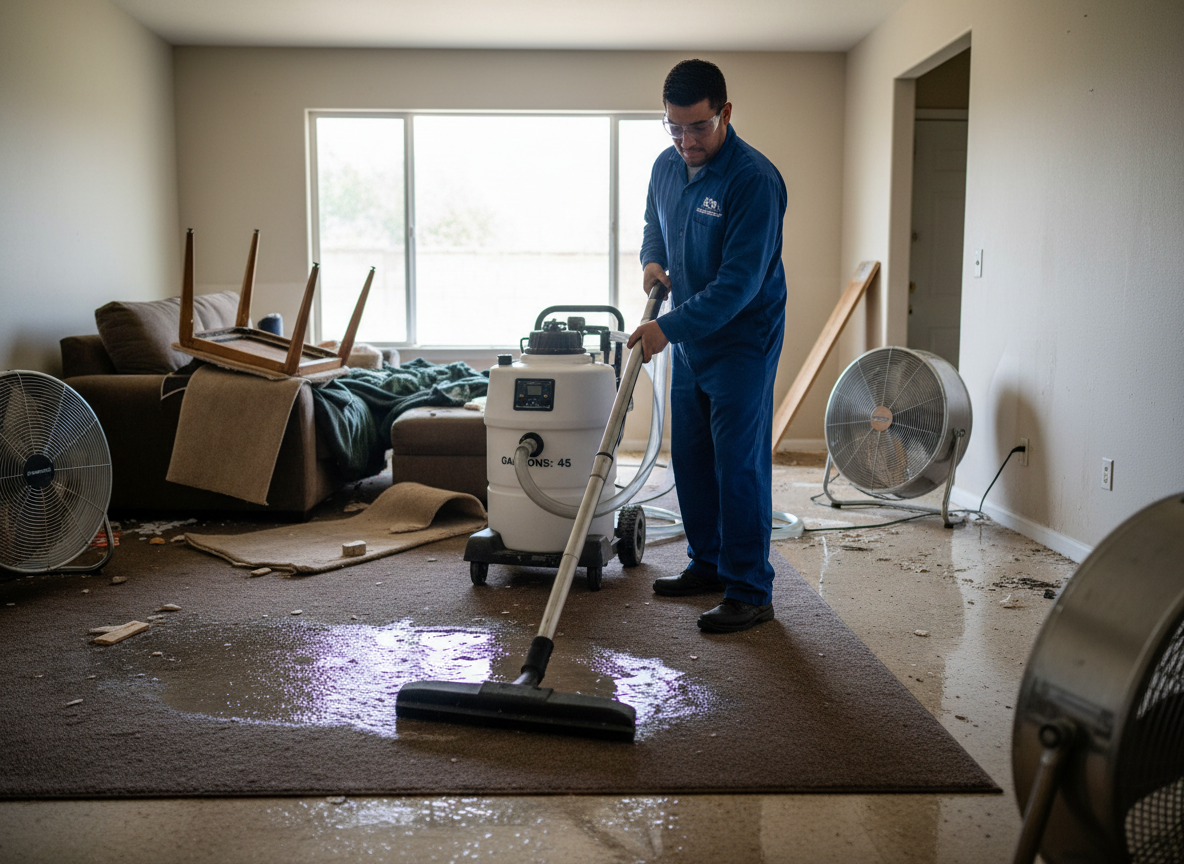
Downey sits in a Mediterranean climate where hot summers can mask slow leaks until winter rains hit. When water pools on the flat lots common near Rio Hondo Golf Club or the older tracts around Rancho Los Amigos, extraction must account for how clay-heavy soil holds moisture against foundations. Industrial vacuums and submersible pumps pull volumes that shop-vacs cannot reach, especially in single-story ranch homes built in the 1950s and 1960s that lack proper under-slab drainage.
Many homes in Downey and nearby Bell Gardens have concrete slabs poured directly on grade. Water that migrates under these slabs travels laterally rather than draining away, so extraction crews often cut strategic access points or use moisture meters to map hidden saturation. Failure to remove every pocket leaves conditions for mold growth that Los Angeles County health codes require remediation to address later.
Paramount and Norwalk border properties share the same seasonal pattern: brief but intense winter storms followed by long dry spells. This cycle drives repeat calls when homeowners attempt DIY extraction and stop too soon. Professional crews continue until relative humidity readings inside wall cavities and under flooring drop below 50 percent, using air movers and dehumidifiers staged for the specific square footage and construction type.
Extraction work in Downey also contends with older galvanized plumbing that can fail during pressure changes after a main break. Crews isolate the source first, then extract before any drywall or flooring removal so the structure can be evaluated for hidden rot along the base plates common in mid-century construction.
Technician insight
In Downey, the thing that catches most people out with Water Extraction is how the flat lots and clay soil around Rancho Los Amigos let water travel under 1950s slabs and reappear days later if extraction stops at the surface.
Slab Leak After Winter Rain Near Paramount Border
Water migrated under a 1962 ranch home slab after a storm. Extraction located the trapped water through meter readings along the foundation. Pumps and drying equipment removed the moisture without cutting finished floors, restoring dry conditions before mold could form.
How it works
- 1
Site Assessment
Technicians arrive within the hour, map water depth and migration paths, and identify slab or crawlspace access points specific to Downey construction.
- 2
Water Removal
High-volume pumps and truck-mounted extractors pull standing water while protecting finished surfaces in living areas near the Downey Civic Theater or Columbia Memorial Space Center.
- 3
Moisture Verification
Infrared cameras and pin meters confirm saturation levels under slabs and inside walls before equipment is staged for drying.
- 4
Final Documentation
Photos and moisture logs are provided for insurance and to guide any follow-up repairs required by local building standards.
Pricing
Pricing is based on water volume, access difficulty, and drying duration; an on-site assessment provides the exact scope before work begins.