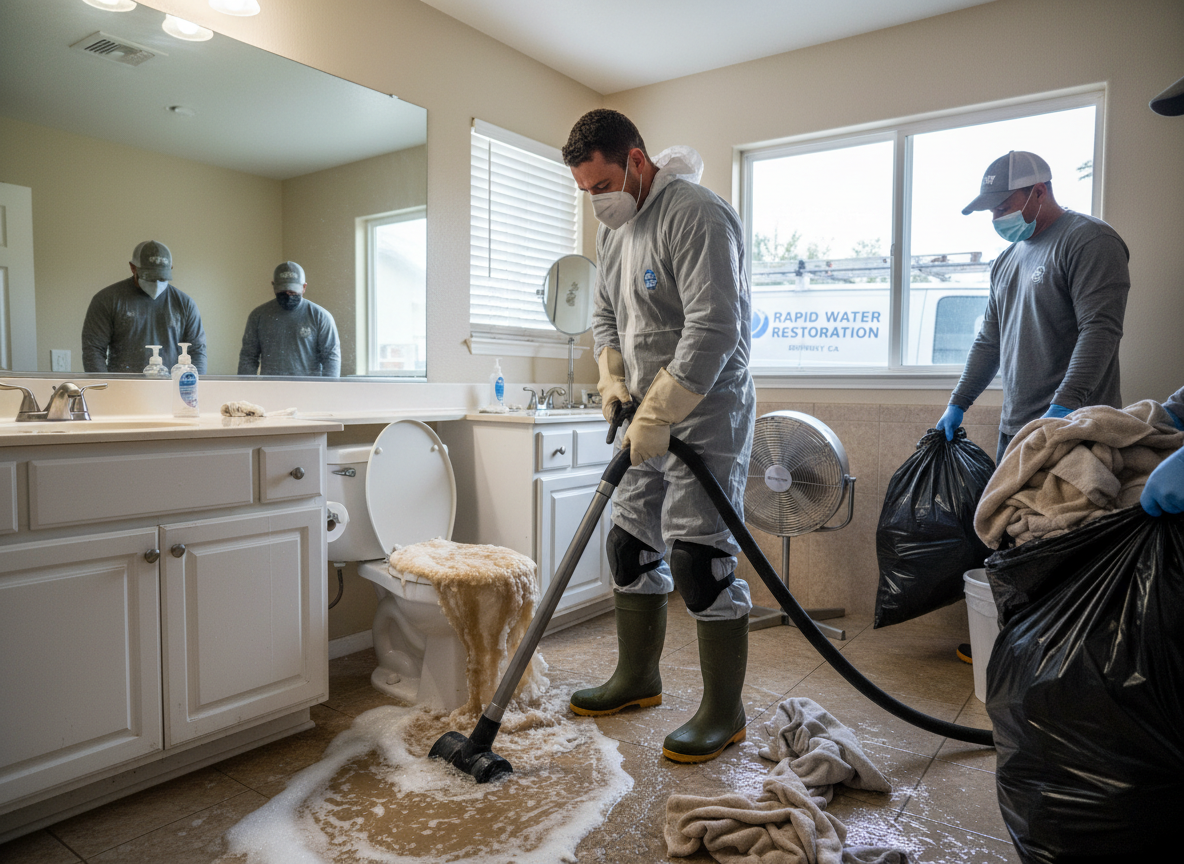
Toilet overflows in Downey often involve category 3 water that requires immediate containment to protect nearby rooms in post-war tract homes common around Rancho Los Amigos. Technicians extract standing water first, then use moisture meters to locate seepage under vinyl or tile floors that can wick into subfloors within hours during the mild winter months when evaporation slows.
Homes near the Downey Civic Theater and Columbia Memorial Space Center frequently feature original cast-iron or galvanized lines that crack from soil movement in Los Angeles County terrain. This allows wastewater to reach wall cavities or crawl spaces, demanding removal of baseboards and targeted drying with air movers and dehumidifiers to prevent mold on drywall paper backing.
Sanitation follows IICRC S500 protocols using hospital-grade disinfectants on all contacted surfaces. In neighborhoods bordering Norwalk, Bell Gardens and Paramount, technicians also check HVAC returns that can spread odors and contaminants if not isolated early, especially after hot summer days when indoor humidity spikes.
Final verification includes thermal imaging to confirm drywall and flooring moisture levels have returned to normal before any reconstruction begins, avoiding callbacks common when hidden pockets remain in older Downey construction.
Technician insight
In Downey, the thing that catches most people out with Toilet Overflow Cleanup is how quickly wastewater travels under 1950s slab foundations near Rio Hondo Golf Club once the mild winter rains raise the water table; homeowners often stop at mopping the floor while the real damage sits in the crawl space.
Overflow Behind a Partition Wall
A toilet overflow in a Rancho Los Amigos area home sent water under a bathroom partition into the adjacent bedroom. Extraction revealed saturation in the particleboard vanity base and carpet pad extending three feet into the room. Crews removed the base, dried the cavity with directed air flow, and applied antimicrobial to framing before reinstalling finishes.
How it works
- 1
Initial Assessment
Technician arrives within the hour, maps affected zones, and identifies water category while protecting unaffected rooms.
- 2
Water Extraction
Standing water is removed using submersible pumps and wands to limit further absorption into subfloors and walls.
- 3
Drying and Monitoring
Air movers, dehumidifiers and moisture meters are deployed; readings are tracked daily until levels stabilize.
- 4
Sanitization and Verification
EPA-registered disinfectants are applied, followed by thermal imaging to confirm hidden moisture has been eliminated.
Pricing
Pricing varies with water volume, number of affected rooms and whether subfloor or wall cavities require opening; upfront quotes provided after assessment.